
“I’m afraid I’m one of those ministries that has traumatized people.”
She sent that in a vulnerable text message.
I called her immediately.
She has been a tremendous blessing in my life over the years.
I never would have described her that way.
“I never meant to traumatize anyone,” she confessed. “I was just trying to be direct in my belief that God can take care of everything. But looking back, I sent people who needed healing to a place of shame by telling them to turn it over to God and let it go.”
I sat quietly, a lump forming in my throat.
She was experiencing a moment of divine clarity. My role wasn’t to rush in with answers — it was simply to hold space for what God was revealing.
Then she said something that broke my heart.
“To be honest, I never liked praying with people one-on-one after I spoke at conferences. I just wanted them to get over it. Sometimes … if I’m really honest … it even felt ‘whiny’ to me.”
Then she said, almost in a whisper:
“Dr. Neecie…I really wanted people to find their answers in God. I just didn’t realize I was shaming them into pushing whatever was hurting them deep inside…and moving on.”
After a long pause, she asked, “What was going on with me?”
I knew it was more lament than question, so I let the silence linger.
Finally, I replied, “That’s almost the right question.”
She looked up curiously as I continued. “But I think the more accurate question is… ‘What was going on in me?'”
Neither of us knew that question would begin a journey deep into the hidden places of her own heart — the very places where her wounds had quietly shaped the way she ministered to others.
(As someone has poignantly said, “Finding faith and/or salvation is a onetime act, but redemption is a lifelong process.”)
The wounds she never healed had become wounds she unknowingly passed on.
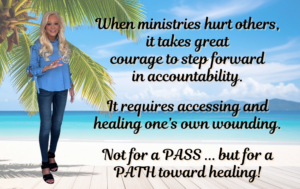 Before we go further, I want to be very clear. I’m not writing this to justify or excuse ministries or ministry leaders who have wounded others.
I’m writing because I want to offer something our Christian culture rarely provides … Not a PASS but a PATH.
A pathway for those who’ve wounded others to honestly…
-acknowledge what happened,
-understand how it happened,
-and begin healing themselves.
Because outside of the relatively few situations involving intentional evil or manipulation, many people genuinely do not realize they’re wounding others.
(Isn’t redemption, at its core, seeing who God desires us to become by showing us who we’ve become, and why?)
Sometimes the deepest wounds are inflicted by people who sincerely believe they’re helping.
In fact, some of the greatest ministry wounds I’ve encountered have come from what I call misguided righteousness.
Not self-righteousness.
That’s different.
Self-righteousness elevates itself above others.
Misguided righteousness sincerely desires to do good — but unintentionally leaves people carrying toxic shame instead of hope.
It speaks truth … without tenderness.
It offers answers … before understanding.
It encourages people to “move on” … before they’ve had a chance to realize that “Blessed are those who mourn for they shall be comforted” which our door to healing.
The results can be devastating. Because whenever ministry leaves someone carrying toxic shame, something has gone terribly wrong.
Good intentions never erase deep wounds.
My conviction has become simple:
When our wounds are healed, we no longer wound others.
That’s why my calling has never been limited to helping those traumatized by ministry. I also want to help ministries heal — so they stop creating more people who need healing.
Humility starts when we know what caused our missteps/troubles in life, and yet we have no idea why we did what we have done. But we want to know why … that’s where surrender starts.
“For when I am weak, then I am strong.”
Paul, an Apostle
1. Wounded People — and Wounded Ministries — Wound People
“I didn’t even know I had wounds buried so deeply that they were driving the way I ministered,” she admitted. “But that’s still no excuse. I can’t blame what I did on what others did to me.”
I smiled gently.
Ironically, that statement revealed something she still couldn’t see … How little kindness she had extended toward herself.
When I say wounded people wound people, I’m not offering an excuse.
I’m not removing responsibility.
And I’m not suggesting that whoever wounded you is somehow responsible for every decision you’ve made since.
Blame has never produced healing. Not once. But blame does to something … it stops ALL desire for change and growth. It’s our guarantee to stay at 50% (at best).
I asked her another question: “Is it possible you’re confusing finding the root…with finding someone to blame?”
She looked at me with a mixture of curiosity and frustration.
“What if we’re not looking for the root so we can excuse the fruit? What if we’re looking for the root…so we can finally pull it out?”
She sat quietly, processing.
“Weeds don’t disappear because we pretend they aren’t there,” I offered.
“They continue growing beneath the surface until they choke the life out of something beautiful. And unresolved wounds often do the very same thing. They choke out grace. They choke out compassion. They chokeout our ability to see the pain sitting right in front of us.”
I watched as her expression changed … that look I recognize when truth and grief arrive simultaneously.
“When unresolved wounds remain buried,” I continued, “they quietly drive us in ways we don’t even recognize. And when we’ve buried our own pain, we often encourage others to bury theirs. When we remained justified, we project that.”
She nodded slowly, her resistance softening.
“I always thought ‘letting go and letting God’ was what I had done,” she admitted. “So naturally I wanted everyone else to do the same. But what I really did … was bury it where I couldn’t see it. Then told myself God had taken it.”
She paused.
“I guess He couldn’t take it while I was standing guard over it with my shovel … chasing Him away every time He came near.”
We both laughed despite her tears. Not because it was funny. But because something had shifted.
Humor has a beautiful way of showing us when truth has finally found a place to land.
For the first time, she could see the difference between burying a wound and healing one. That distinction changes everything.
It’s one of the reasons Step One of my Seven-Step Healing Process is Debrief.
A healthy debrief is not about blaming.
It isn’t about justifying what our wounds have driven us to do.
It’s about laying down the shovel.
It’s about releasing the guards we’ve posted around our pain.
It’s about allowing our story to finally pour out so the toxicity can be removed, and true healing can begin.
Her realization that she had unhealed wounds was just as important as the realization of those who had been wounded by ministry.
Because every ministry wound has a beginning.
And every ministry wound can have an ending.
But both begin in the same place.
At the door of healing.
2. Acknowledge How You’ve Wounded Others — Without Condemning Yourself
“I never dreamed I was wounding people when I would say things like…
‘Just let it go and let God.’
‘Leave it at the foot of the cross.’
‘You can’t help others if you can’t get over what happened to you.’
‘Just focus on the good things God has done.'”
Her voice cracked as she repeated words she’d spoken for years. Not because she’d intended to hurt people. But because she suddenly realized she had.
I nodded with compassion. I could almost feel the weight settling on her shoulders as she replayed hundreds of conversations through an entirely different lens.
“You were trying to help,” I said gently. “But without realizing it, you were cutting off their opportunity to debrief … to pour out the very thing they desperately needed to release.”
“When people don’t have permission to tell their story, the wound doesn’t disappear. It simply goes underground. And underground wounds don’t stay quiet. They grow. They give birth to deeper shame … to cynicism .. .to hopelessness … And to the haunting belief that perhaps they’re not spiritual enough, or haven’t prayed enough, because they still hurt.”
She lowered her head. “That’s exactly what I did…”
Then, almost whispering: “My desire to help became filthy rags.” I immediately reached for her hand.
“No,” I said softly.
“Your desire to help was beautiful.
It was simply flowing through wounds that had never been healed.”
There is an enormous difference between those two statements.
One leads to condemnation.
The other leads to compassion.
One says, “I’m a terrible person.”
The other says, “I finally understand why I kept doing something that hurt people — and now I can change it.”
That distinction matters.
Because shame has never transformed anyone.
Love does.
Truth does.
Grace does.
Self-condemnation is not repentance.
It’s simply another form of shame.
What I wanted for her was something far healthier. Acknowledgment.
There’s a beautiful progression that leads toward healing:
First — we honestly recognize that our intentions were good.
Then — we courageously acknowledge that our actions may have caused pain anyway.
Next — we allow ourselves to feel genuine compassion for those we’ve wounded.
Finally — we extend that same compassion toward ourselves. Not to excuse what happened. But to create enough safety to change.
That’s where healing begins.
Healing always begins with truth…wrapped in grace.
Several months later she said something I’ll never forget.
“If I had my entire ministry to do over again, the very first thing I’d do is take your Trauma Coach Training. It forced me to see people through the eyes of Jesus. I’ve spent decades trying to help people become spiritually stronger. But I never realized how rarely I stopped long enough to see how deeply they were hurting.”
Then she added words I’ll carry for the rest of my life. “I don’t think I ever looked at myself that way either.”
There it was.
The real wound.
She’d spent a lifetime extending expectations … when what she had needed all along was compassion. For herself. And for others.
“I always thought strength meant pushing through,” she continued.
“Now I realize strength sometimes looks like sitting with someone long enough that they no longer feel alone.”
I don’t pretend to understand everything about Jesus. But this much I know.
He never used truth as a weapon.
He never wielded righteousness to leave people drowning in shame.
Truth and tenderness walked together wherever He went.
He confronted … without condemning.
He invited … before He instructed.
He restored … before He redirected.
(Think of the Sermon on the Mount. It was not only the greatest sermon of ever shared…but it was God inviting us to feel what we need to feel to find the truth in doing so.)
Every encounter drew people closer to the Father … not because they felt judged, but because they felt seen.
Perhaps that’s why broken people were so drawn to Him. And perhaps that’s still what the world is longing for today.
Not ministries that simply proclaim truth. But ministries that carry truth with such tenderness that wounded hearts finally believe healing is possible.
That’s everyone’s door to redemption!
Because there was … and is … no place for wounding others in the ministry of the One, who came to bind up the brokenhearted.
3. Healing Ourselves — So We Stop Hurting Others
Whenever I talk about helping ministry leaders heal, I know some people become uncomfortable.
Many have spent years carrying wounds that came from the very people entrusted with caring for them. The last thing I ever want to do is minimize that pain.
For more than 30 years I’ve had the sacred privilege of sitting with those whose hearts were broken — not by the world — but by the Church.
I’ve listened to stories of shame.
Stories of rejection.
Stories of spiritual manipulation.
Stories of words that echoed for decades.
Those wounds matter.
They deserve to be acknowledged.
They deserve to be grieved.
And they deserve to heal.
But somewhere along the way I realized something that changed me.
If we only help those who’ve been wounded … and never help those who unknowingly became the ones doing the wounding … we haven’t ended the cycle.
We’ve simply changed who gets hurt next.
That’s why I believe healing belongs to all of us. To those who carry scars. And to those who never intended to leave them.
Because there’s no place for leaving wounded people feeling more wounded after encountering the heart of Jesus.
Any ministry that leaves people carrying more shame than hope has drifted from the heart of Jesus.
Jesus never added shame to a wounded heart.
Neither should His Church.
Our calling has never been to increase people’s shame. Our calling is to increase their hope. And their belief.
The measure of healthy ministry is not how many people come through our doors. It’s how many leave believing there is more hope than shame …
because they encountered the heart of Jesus.
I’ve watched something beautiful happen when leaders become willing to heal.
Ministries become more tender and compassionate … without becoming weaker.
Leaders become humbler … without becoming less courageous.
Truth continues to be spoken … but shame is no longer used as a tool.
People stop feeling managed … and start feeling known and gently led.
People stop feeling judged … and start feeling seen and heard.
And somehow, through ordinary conversations … the heart of Jesus becomes unmistakable.
That’s the kind of ministry I want to help heal, build, and restore.
Not perfect ministries.
Healing ministries.
Not leaders who pretend they’ve never been wounded. Leaders who are humble enough to let God continue healing them.
Because healed leaders create safe places.
Safe places create honest conversations.
Honest conversations create transformed lives.
And transformed lives change generations.
*****
So, whether you’ve been wounded by ministry — or you’ve come to realize you’ve unknowingly wounded others — I want to invite you into the same place.
Into the light.
Not because that’s where you’ll be exposed.
Because that’s where you’ll be healed.
Healing isn’t about giving ANYONE a PASS.
It’s about giving EVERYONE a PATH.
And perhaps that’s been God’s invitation all along. Not simply to build bigger ministries. But to become safer havens — and truer reflections of the heart of Jesus.
The healthiest ministries are not led by perfect people. They are led by people who never stop allowing God to heal their own hearts. They’re led by people who want to know your story and mine.
And when that happens — people don’t just encounter a church.They encounter the heart and presence of Jesus.
He was the best at asking questions.
Ever wonder why would the one who knows our story better than we do, would want to hear us tell it?
Because this Author trusts the editor to make the story come true.